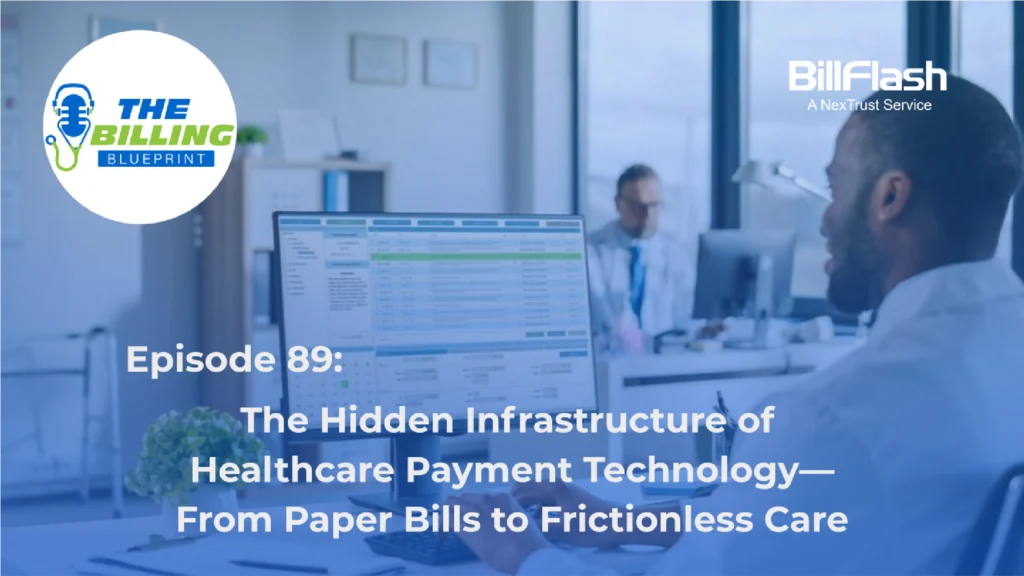
Healthcare payment technology is transforming how patients and medical practices manage the financial side of care. While modern medicine has become increasingly sophisticated, healthcare billing and payment processes have often remained complicated, paper-heavy, and difficult to navigate.
In this episode, we explore how healthcare payment technology is helping bridge that gap through digital patient portals, QR code payments, text and email payment reminders, mobile wallets, autopay, flexible financing, and integrated payment solutions. We look at how these tools can reduce administrative friction, improve cash flow, simplify the patient experience, and make healthcare payments more accessible and convenient.
We also look at the business side of healthcare payments, including revenue cycle management, cash flow, patient engagement, EHR integrations, automation, and the challenges created by fragmented billing systems.
Transcript
Narrator: 00:00
Welcome to the Billing Blueprint Podcast, your go to resource for innovative medical billing solutions. Each episode we explore the latest industry trends and share proven strategies to help your practice streamline operations and get paid faster. Now here are your hosts, Brad and Sarah.
Sarah: 00:23
We live in an era where modern medicine is, you know, essentially indistinguishable from magic. I mean, a surgeon can use a robotic arm to perform a heart valve replacement from 3,000 miles away.
Brad: 00:36
Whoa. Yeah, it’s incredible, right?
Sarah: 00:39
We can map the human genome in an afternoon. But if you want to actually pay for that medical miracle, that is a whole different story. You are probably going to have to walk to your mailbox, like three weeks later, open a densely confusing piece of paper, hunt down a checkbook you haven’t used since 2019, find a stamp.
Brad: 00:57
A stamp? Who even has stamps anymore?
Sarah: 00:59
Exactly. You have to find a stamp and mail this piece of paper into the void. It is just this massive jarring disconnect. We have space age medicine, but we are paying for it with stone age administration.
Brad: 01:11
The contrast is definitely stark, and, well, it turns what should be a moment of relief for you, like getting a clean bill of health or a solid treatment plan into an immediate source of dread.
Sarah: 01:22
Yeah, that lingering anxiety.
Brad: 01:23
Right, right. You leave the clinic feeling great, and a month later you are staring at a multi-page invoice trying to decipher medical billing codes, wondering if you owe $20 or $2,000, which is the exact.
Sarah: 01:36
Frustration we are tearing into today. We have a really comprehensive guide in front of us by a company called BillFlash. It is titled “Your Guide to Choosing the Right Types of Payment Methods for Your Healthcare Practice.” Now, on the surface, a deep dive into medical billing infrastructure might sound like something a hospital administrator would care about.
Brad: 01:57
Sure.
Sarah: 01:58
But how these systems operate is fundamentally shifting your entire experience as a patient. Okay, let’s unpack this. Our mission today is to look at the underlying mechanics of how we pay our doctors, because this seemingly mundane operational detail is quietly becoming one of the most critical factors in modern healthcare.
Brad: 02:14
And to really understand the stakes here, we have to look at the reality of the current financial landscape. For the average person, out of pocket costs and high-deductible health plans have hit historical peaks.
Sarah: 02:25
They really have.
Brad: 02:26
Patient financial responsibility is no longer just, you know, a small copay at the front desk. It often represents a significant portion of the clinic’s total revenue. So, the pressure point is massive for both sides, really. Exactly. If the friction of actually rendering that payment is too high, the medical clinic suffers severe cash flow. Bottlenecks. But more importantly, from a patient perspective, if the payment process is opaque or just unmanageable, it becomes a direct barrier to you accessing care in the first place.
Sarah: 02:57
Let’s start with the consumer expectation side of this, because the guide highlights a massive gulf between what we want and what clinics actually provide.
Brad: 03:05
The data on this is super telling.
Sarah: 03:07
It is. The data shows that 65% of consumers expect their payment experience to be completely frictionless. And taking that a step further, 84% prefer one click checkouts, which, I mean…
Brad: 03:19
That aligns perfectly with our baseline expectations in every other sector of the economy.
Sarah: 03:23
Right. But the implementation in healthcare is completely absent. I can walk into a crowded cafe, order a highly customized beverage, and pay for it by briefly hovering my smartwatch near a piece of plastic.
Brad: 03:34
You’re out the door.
Sarah: 03:35
The transaction takes half a second, but for a medical procedure, I am thrown back in time. Why is the healthcare industry so stubbornly resistant to something as simple as a digital checkout?
Brad: 03:47
What’s fascinating here is it isn’t simply a matter of doctors being stubborn or afraid of new technology. The bottleneck is the underlying mechanics of health care billing itself.
Sarah: 03:57
Okay, how so?
Brad: 03:58
Well, your coffee analogy highlights a static transaction. The price is known instantly, and the fulfillment is immediate. Health care billing is a fragmented, multi-party negotiation.
Sarah: 04:09
Right, the insurance stance.
Brad: 04:11
Exactly. When you leave the exam room, the doctor has to generate a super bill. Then a medical coder translates your symptoms into specific alphanumeric codes.
Sarah: 04:19
Sounds complicated already.
Brad: 04:21
Oh, it gets worse. That gets sent to a clearinghouse, then routed to your insurance provider. The insurer runs it through an adjudication algorithm to determine what your specific policy covers, what your deductible is, and what network discounts apply.
Sarah: 04:36
So, it’s bouncing around all these different systems?
Brad: 04:38
Yes. And only after they send a remittance advice back to the clinic does the front desk actually know what you the patient owe.
Sarah: 04:46
So, by the time I am walking to my car, the clinic literally doesn’t even know what to charge my credit card.
Brad: 04:52
Yet in many cases, yes. They have no idea the backend systems required to manage that 30-to-45-day cycle were built decades ago. Because these legacy systems are so deeply entrenched and frankly, incredibly fragile, practice managers are terrified to unplug them.
Sarah: 05:08
Well, they don’t want to break the whole operation.
Brad: 05:09
Right, and the source reveals a staggering metric on this. 58% Of medical providers still rely entirely on paper statements for patient billing.
Sarah: 05:18
Wait, entirely? Like more than half?
Brad: 05:20
More than half.
Sarah: 05:21
That means the majority of the medical industry is operating its financial infrastructure like it is 1995.
Brad: 05:26
Pretty much, yeah.
Sarah: 05:28
But surely that hesitation to upgrade is costing them. I mean, if the friction is that high for me as a patient, I’m inevitably going to delay that payment. I’ll put the paper bill on my kitchen counter, promise I’ll decode it on the weekend, and then completely forget about it.
Brad: 05:42
That kitchen counter phenomenon is exactly what the guide identifies as a primary driver of abandoned payments. The friction doesn’t just annoy you; it directly damages the clinic’s bottom line. The harder it is to render payment, the lower the collection rate.
Sarah: 05:57
Logically, then, the solution seems incredibly obvious. If physical paper is the root cause of the friction, the delayed payments and all the administrative bloat, clinics should just eradicate it. Force a completely digital mandate. Stop mailing bills and push everything to email.
Brad: 06:13
You’d think so, right? A completely digital mandate sounds like the ultimate fix, but the data completely upends that assumption.
Sarah: 06:21
Really?
Brad: 06:21
Yeah. The source points out that over 50% of patients still prefer receiving mailed paper statements alongside their digital ones.
Sarah: 06:28
I was completely thrown by that statistic when I read it. My immediate thought was that this must just be an older demographic who is, you know, uncomfortable with smartphones.
Brad: 06:37
The demographic divide plays a role. Certainly, older adults often lean toward familiar tactile experiences. But the reliance on physical paper cuts across all age groups for highly practical, mechanical reasons.
Sarah: 06:51
Like what?
Brad: 06:52
Well, think about what a medical bill actually represents. It isn’t a simple receipt for a cup of coffee. It is an itemized ledger of complex services.
Sarah: 07:01
Okay, I see where this is going. When I get an explanation of benefits, it can be three pages long with a dozen different line items, adjustments and coinsurance percentages.
Brad: 07:10
Exactly. Now try auditing a three page, heavily coded document on a six-inch smartphone screen.
Sarah: 07:17
Oh, it’s a nightmare. Lots of zooming and scrolling.
Brad: 07:19
It is incredibly frustrating. Patients use physical bills as a dashboard. They lay them out on a table to cross reference with their insurance portals to ensure cost transparency and verify they aren’t being double charged.
Sarah: 07:31
Because errors happen all the time.
Brad: 07:33
All the time. Furthermore, they need physical records for tax audits, flexible spending accounts, and just long-term medical record keeping.
Sarah: 07:42
That makes a lot of sense. The physical paper serves as a necessary anchor for a highly complicated transaction. But that leaves the clinic in a bind.
Brad: 07:50
It does.
Sarah: 07:51
The patient wants the paper for auditing, but the paper creates a payment bottleneck for the clinic. I assume the fix isn’t just emailing a PDF, because an emailed PDF is just going to get lost in my spam folder.
Brad: 08:02
A PDF doesn’t solve the core mechanical friction of actually extracting the funds. This is where the guy details a highly effective hybrid approach developed by BillFlash.
Sarah: 08:12
How does that work?
Brad: 08:13
They maintain the physical mailed statement to satisfy the patient’s need for a tactile record, but they embed a QR code directly onto the paper bill.
Sarah: 08:21
So, the paper is the audit tool, and the phone becomes the payment terminal.
Brad: 08:24
Exactly. You satisfy the human demand for physical cost transparency, but you execute the transaction with the one click frictionless speed that 84% of consumers demand.
Sarah: 08:35
It bridges the physical and digital gap beautifully, but you know that only solves the problem once the bill actually arrives. We are still talking about reacting to a piece of paper weeks after the appointment, right?
Brad: 08:47
The timeline is still delayed.
Sarah: 08:48
Yeah. If we want to fix the revenue cycle, shouldn’t clinics be focusing on the timeline? Moving from a reactive stance to a proactive one?
Brad: 08:55
That is the next major shift outlined in the source. Proactive digital engagement. The guide focuses heavily on mechanisms like PreBill, eBills, and automated PayReminders that get pushed directly to a patient’s mobile device via text or email.
Sarah: 09:09
Now I have to push back a little on the text messaging aspect. In today’s digital climate, our phones are bombarded with spam and phishing attempts.
Brad: 09:18
Oh, constantly.
Sarah: 09:19
If my dentist texts me a link that says click here to pay your balance, my immediate instinct is to assume it is a scam and delete it. Is there actual data showing patients will engage with medical billing via text message?
Brad: 09:31
The hesitation is completely valid. We all get those spam texts, but the user behavior data tells a different story. The Source notes that 88% of patients are already utilizing a medical provider’s online portal for some aspect of their care.
Sarah: 09:45
88%. Wow.
Brad: 09:47
Yeah. And among those users, over half are logging in multiple times a month to check lab results, schedule appointments, or message their doctors.
Sarah: 09:55
So, the behavioral pathway is already paved. The patient already trusts the digital ecosystem.
Brad: 10:00
Of their provider precisely because that digital trust is established. Moving the financial transaction into that same established channel is seen as a convenience, not an intrusion.
Sarah: 10:12
That makes sense.
Brad: 10:13
The guide details how BillFlash utilizes a platform called PayWoot.com to manage this. It provides 24/7 Portal access where patients can view their balance and pay using integrated mobile wallets like Apple Pay and Google Pay.
Sarah: 10:28
Oh, I love Apple Pay.
Brad: 10:29
It’s so easy. And it even allows them to establish auto pay parameters for recurring treatments. If we connect this to the bigger picture, the operational impact of pushing payments to a 24/7 digital portal is huge.
Sarah: 10:41
I can imagine, because I know firsthand what happens when a confusing paper bill shows up without a clear way to pay it. You call the clinic.
Brad: 10:49
And that phone call is the hidden drain on the entire healthcare system.
Sarah: 10:52
It really is.
Brad: 10:53
The guide cites a study demonstrating that the effective implementation of patient portals in digital payment tools reduces telephone encounters and physical office visits by 14% to 19% annually.
Sarah: 11:04
Nearly a 20% drop in phone volume simply by clarifying the bill and providing a text link.
Brad: 11:11
Think about the mechanics of a front desk. Every time a patient calls to ask about a line item or read their credit card number aloud, they are consuming 10 to 15 minutes of administrative bandwidth.
Sarah: 11:22
Someone has to manually type it all in.
Brad: 11:24
Exactly. That is a human bottleneck. By automating the payment collection and providing transparency through a portal, you eliminate that friction. The front desk staff is freed from acting as a call center for collections.
Sarah: 11:37
Which means when a patient is actually calling because they have a severe medical issue, the line isn’t tied up by someone trying to pay a copay.
Brad: 11:44
Yes, the efficiency directly translates to better patient care.
Sarah: 11:48
But all of these mechanisms, QR codes, Apple Pay, text links, they all operate one massive fundamental assumption. They assume the patient actually has the liquidity sitting in their checking account to clear the balance.
Brad: 12:01
Which brings us to the most significant barrier in modern healthcare. Streamlining the checkout process is irrelevant if the patient fundamentally cannot afford the underlying cost of the care.
Sarah: 12:11
Here’s where it gets really interesting, because the guide introduces new medical financing structures, specifically mentioning BillFlash’s PlanPay and FlexPay system. When I was looking through this section, the immediate parallel that came to mind was the buy now, pay later model that has completely taken over e-commerce. You know, you buy a laptop online and the checkout page lets you split it into four easy payments, right?
Brad: 12:35
Very popular right now.
Sarah: 12:37
But the mechanics of consumer retail are very different from healthcare. From a traditional banking perspective, medical financing has always been incredibly rigid, right?
Brad: 12:46
Highly rigid. Historically, if a patient couldn’t cover an out-of-pocket procedure, their primary option was applying for a specialized medical credit card through a third-party bank.
Sarah: 12:57
I’ve seen brochures for those in the waiting room.
Brad: 12:59
Yeah, they’re everywhere. But the underwriting algorithms for those traditional medical cards operate much like a standard premium credit card. They typically require a FICO credit score of 700 or higher for approval, which.
Sarah: 13:12
Completely excludes the exact demographic that needs the financing the most. I mean, if you have a massive unexpected medical bill, there is a high probability it has already negatively impacted your credit utilization. You are locked out of the very system designed to help you.
Brad: 13:27
It is a systemic paradox. It really is. But the source details how the FlexPay model mechanically bypasses this traditional underwriting roadblock. FlexPay adjusts the risk model to accept credit scores as low as 500.
Sarah: 13:41
Wait, I need to stop you right there. Because from a purely mechanical financial standpoint, how does that work?
Brad: 13:46
That’s a valid question.
Sarah: 13:48
How does a financing partner instantly approve a 500-credit score for a medical procedure without taking on catastrophic default risk and going bankrupt? That just defies traditional lending logic.
Brad: 13:58
It requires a major shift in how the debt is structured and managed between the clinic, the patient, and the platform. In the FlexPay model, the application takes less than a minute directly through the digital portal.
Sarah: 14:09
So, no awkward paper forms in the waiting room.
Brad: 14:12
None. And because the underwriting criteria are broader, often looking at factors beyond just a standard FICO score, they achieve a 90% acceptance rate.
Sarah: 14:22
90%. But who holds the bag if the patient defaults? Like, does the doctor have to wait 12 months to see if they actually get paid for the surgery they perform today?
Brad: 14:30
No. And that is the critical mechanism that makes this viable for the healthcare industry. The financing partner pays the medical practice in full immediately.
Sarah: 14:39
Oh, wow.
Brad: 14:39
Yeah. The clinic is made entirely whole on day one, allowing them to balance their books, pay their staff, and maintain cash flow. The financing platform then assumes the management of the installment plan with the patient.
Sarah: 14:51
That is a fundamental paradigm shift. It completely insulates the medical provider from the collection risk While giving the patient the flexibility they need.
Brad: 14:59
Exactly.
Sarah: 15:00
And the downstream effect of this is profound. I mean, if you remove the terror of a massive immune system, immediate upfront cost, you prevent patients from delaying or abandoning necessary medical treatments. The financial mechanism literally improves clinical health outcomes.
Brad: 15:16
That is the ultimate goal. You transition a hard financial roadblock into a manageable monthly process, keeping the patient engaged in their own care.
Sarah: 15:24
So, we have unpacked an arsenal of payment technologies. Today we have in office terminals for contactless payments, QR codes printed on physical paper, text message reminders, 24/7 Digital portals, and highly flexible financing options like FlexPay. It’s a lot of tools but put yourself in the shoes of a clinic administrator for a second. If I go out and purchase five different software solutions to handle these five different tasks, haven’t I just created an absolute IT nightmare?
Brad: 15:51
Oh, absolutely.
Sarah: 15:52
I am picturing a front desk receptionist trying to juggle five different browser windows manually typing data from the QR system into the financing system.
Brad: 16:00
You Are describing the exact fragmentation track that destroys administrative efficiency. Bolting together disparate software tools from multiple vendors creates data silos and lots of headaches. Tremendous headaches. It leads to manual data entry errors, lost revenue and massive staff burnout. The Source emphasizes that the final essential step in modernizing healthcare payments is adopting an integrated end to end ecosystem.
Sarah: 16:27
So, everything has to talk to each other seamlessly. But how does a modern cloud-based platform actually integrate with the legacy infrastructure we talked about earlier? Because you mentioned that 58% of clinics are essentially stuck in the 90s.
Brad: 16:39
It comes down to API architecture and direct integrations. Solutions like BillFlash are designed as unified hubs that handle billing, payments, collections, patient communications and financing under one roof.
Sarah: 16:52
Okay, all in one place, yes.
Brad: 16:54
But crucially, they don’t force the clinic to rip out their existing core software. The platform integrates directly with over 100 existing electronic health records or EHR systems.
Sarah: 17:05
So, the EHR is the central brain of the clinic, holding all the medical histories and coding. And this payment hub just snaps onto it. Like a modular upgrade?
Brad: 17:13
Exactly. When a payment is made via a QR code at midnight, the end-to-end system automatically pushes that data back into the legacy EHR. Obtain the patient’s ledger without a human ever having to manually type paid into a spreadsheet.
Sarah: 17:28
That’s amazing.
Brad: 17:29
And because it handles sensitive data, the entire ecosystem is built with non-negotiable security standards. So, PCI compliance for the credit card data and compliance for the medical data.
Sarah: 17:39
I imagine this centralized hub also makes features like autopay significantly easier to manage.
Brad: 17:47
From an accounting perspective, autopay is the holy grail of revenue cycle management.
When a patient puts a card on file in the secure hub and authorizes automated payments up to a specific threshold, the clinic can forecast their cash flow with incredible accuracy.
Sarah: 17:59
No more guessing who is going to pay this month, right?
Brad: 18:01
It removes the volatility of the 45-day billing cycle and replaces it with predictable stability.
Sarah: 18:06
Okay, we have covered exactly why the clinic needs this backend integration to survive financially. But let’s bring this back to the patient for a minute. We started this deep dive by talking about the consumer expectation of a frictionless experience, right? Does all this backend software integration actually dictate patient behavior? Because historically, people chose doctors based on location, insurance networks and clinical reputation.
Brad: 18:31
Reputation, historically, yes. But the landscape is shifting rapidly, and the guide drops a statistic that should serve as a massive wake up call for every practice manager in the country. According to a U.S. bank Healthcare study cited in the source material 32.5% of consumers state they would switch to a different healthcare provider specifically to get access to digital and flexible payment plans.
Sarah: 18:56
Wait. I really want to make sure I am grasping the gravity of that. Nearly a third of patients would fire their current doctor, someone who knows their medical history, someone they presumably trust with their physical health solely because the clinic’s billing software is too clunky.
Brad: 19:11
Nearly a third the tolerance for administrative friction has evaporated.
Sarah: 19:16
That is absolutely wild. We have journeyed from the stubborn persistence of paper statements into a reality where QR codes are alternative underwriting for low credit scores and automated text portals are literally reshaping the market dynamics of the medical industry. We expect the checkout experience at our doctor’s office to be as seamless as buying a book online. So, what does this all mean?
Brad: 19:41
Well, this raises an important question, and it is a provocative thought to leave you with. As these financial ecosystems become increasingly invisible and frictionless, how long will it be until the convenience of a clinic’s operational software becomes just as heavily weighted in our minds as the doctor’s actual clinical expertise?
Sarah: 19:58
That’s a fascinating point.
Brad: 20:00
If a third the population is already willing to walk away over a confusing bill, could the future winners of the medical industry be decided not in the operating room, but entirely by the design of their checkout screen?
Sarah: 20:10
It is a jarring thought, but based on the mechanics we’ve unpacked today, it feels like an unavoidable reality. The next time you find yourself walking to your car after a medical appointment, take a moment to look at how that clinic handles what comes next.
Brad: 20:24
Absolutely.
Sarah: 20:25
The way they process your payment isn’t just a back-office chore anymore. It is the definitive frontline of modern healthcare competition. Thank you for joining us on this deep dive into the hidden infrastructure of healthcare payments. Keep questioning the systems around you and stay curious.
Narrator: 21:22
Thanks for tuning into the Billing Blueprint podcast. For more insights or to dive deeper dive deeper into today’s topics. Head over to billflash.com. Don’t forget to subscribe and we’ll catch you next week with more strategies to keep your practice running smoothly and getting paid faster.
Sources:
Your Guide to Choosing the Right Types of Payment Methods for Your Healthcare Practice