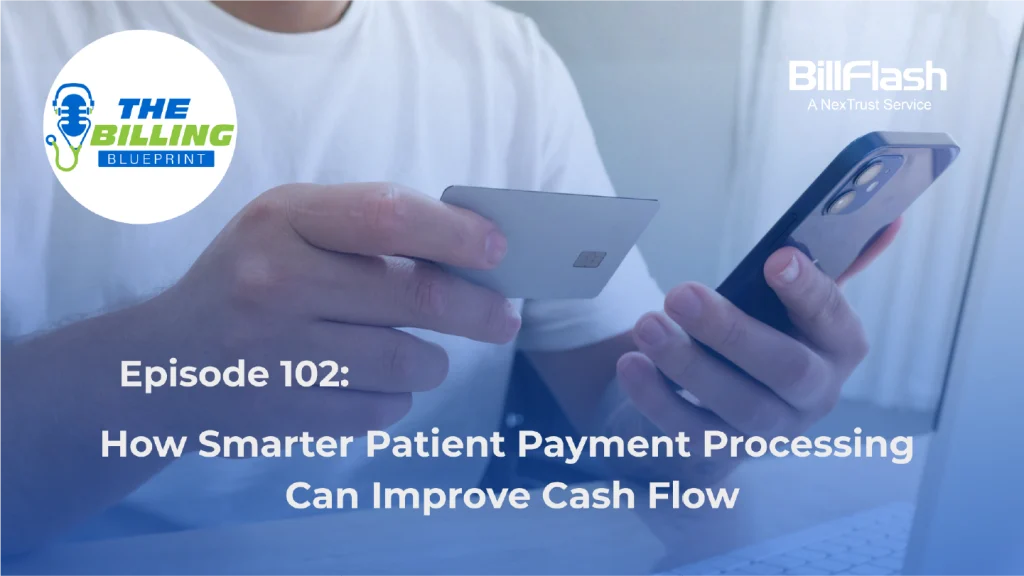
Healthcare practices need more than a way to accept a card payment—they need a connected approach to patient payment processing that supports communication, follow-up, financing, collections, reporting, and faster access to revenue.
In this episode of the Billing Blueprint Podcast, we explore the key questions healthcare organizations should ask when evaluating their patient payment processing strategy. From settlement speed and transparent pricing to two-way patient messaging, automated reminders, integrated collections, patient financing, and EHR/PMS connectivity, we break down the capabilities that can help practices reduce friction and improve cash flow.
The episode also examines how rising patient responsibility and affordability challenges are changing what practices need from payment technology. You’ll hear how solutions like PayerMessages, PayReminders, FlexPay, integrated collections, and PayBot can help reduce manual work, improve communication, and make it easier for patients to resolve what they owe.
Tune in to learn why modern patient payment processing should function as a connected ecosystem—not a collection of disconnected tools—and how the right platform can help practices get paid faster while creating a smoother financial experience for patients.
Transcript
Narrator: 00:01 Welcome to the Billing Blueprint Podcast, your go to resource for innovative medical billing solutions. Each episode we explore the latest industry trends and share proven strategies to help your practice streamline operations and get paid faster. Now here are your hosts, Brad and Sarah.
Brad: 00:23 You know that very specific feeling of dread when you check your mail and see an envelope from a hospital or a doctor’s office?
Narrator: 00:31 Oh, yeah. The absolute worst.
Brad: 00:33 Right?
Narrator: 00:33 Right.
Brad: 00:34 You open it up and it’s a medical bill. But it doesn’t look like any normal bill you’ve ever seen.
Narrator: 00:40 Not at all.
Brad: 00:41 It’s got these weird codes, adjustments you don’t understand, and a bottom line that just makes you want to lie down for a minute.
Narrator: 00:47 Yeah. Take a deep breath.
Brad: 00:48 Exactly. And that uniquely stressful experience, well, it’s the result of a fundamentally broken system.
Narrator: 00:55 It really is.
Brad: 00:56 And so today we are unpacking exactly why the medical billing process is sinking practices, and how shifting from a simple, kind of outdated point-of-sale mentality to a complete payment ecosystem is attempting to fix cash flow for doctors and the experience for patients at the exact same time.
Narrator: 01:15 Because they are deeply connected.
Brad: 01:17 Right. We are pulling this apart based on an insightful article from BillFlash detailing the “7 Questions to Ask Before Choosing a New Payment Processing Ecosystem.”
Narrator: 01:26 It’s a great piece.
Brad: 01:27 It really is.
Narrator: 01:28 Really eye opening.
Brad: 01:29 Okay, let’s unpack this. Because I like to think of medical billing like an iceberg.
Sarah: 01:34 Oh, an iceberg. I like that.
Brad: 01:36 Yeah. So most of us think paying a medical bill is just the tip of the iceberg, right? Just swiping a card at the front desk.
Sarah: 01:42 Right. The visible part.
Brad: 01:43 But the massive hidden structure underwater is what actually sinks a medical practice. We’re talking settlement delays, communication breakdowns, bad debt. All that stuff lurking below the surface.
Sarah: 01:53 That is a highly accurate way to visualize it, because the friction you feel as a patient is just a symptom of that underwater mess.
Brad: 01:59 Yeah.
Sarah: 02:00 A true ecosystem, unlike that iceberg, involves everything from patient communication and financing to automated follow-up and reporting.
Brad: 02:08 Instead of just disconnected pieces.
Sarah: 02:10 Exactly. Rather than relying on several disconnected vendors, it brings it all into the light.
Brad: 02:15 Which means we really need to start at the logical beginning of any transaction. The moment money supposedly changes hands.
Sarah: 02:22 The swipe.
Brad: 02:23 The swipe. Right. So when you are standing at the front desk and you tap your phone to pay a copay, you naturally assume the clinic just got that money.
Sarah: 02:31 You’d think so. Yeah.
Brad: 02:32 But in medical billing, it’s kind of an illusion, isn’t it?
Sarah: 02:35 It absolutely is an illusion. The first major question any practice has to evaluate is the actual timeline of their revenue.
Brad: 02:41 Because it’s not instant.
Sarah: 02:42 Not even close. The reality for most healthcare practices is that standard processors, these legacy systems, they take two to three business days to actually settle those funds.
Brad: 02:51 Two to three days.
Sarah: 02:52 Or more, yeah, depending on how many different vendors they have patched together. It can take even longer for the money to hit the provider’s bank account.
Brad: 03:01 Wait, I need to push back on this for a second. Isn’t a processing fee just a fee? Why is the actual timeline of 2 versus 3 days so critical if the money is guaranteed?
Sarah: 03:11 What’s fascinating here is the compounding effect of delayed cash flow on small businesses.
Brad: 03:16 Okay, how so?
Sarah: 03:17 Well, think about most independent medical practices. They operate on incredibly strict margins.
Brad: 03:23 That makes sense.
Sarah: 03:24 So if you have thousands of dollars sitting in digital limbo for half a week every single week, you are forcing that business into artificial scarcity.
Brad: 03:33 Because the bills don’t stop.
Sarah: 03:34 Exactly. They still have to make payroll on Friday. They still have to pay for medical supplies.
Brad: 03:39 So they’re waiting on their own money.
Sarah: 03:41 Right. And when settlement is perpetually delayed, clinics often have to tap into lines of credit just to float their operations.
Brad: 03:48 Oh, wow. Which costs them interest.
Sarah: 03:50 Which costs interest, yeah. So BillFlash solves this by offering next-business-day deposits. The lag is essentially erased.
Brad: 03:57 So they’re operating on the cash they actually earned, not imaginary future money.
Sarah: 04:01 Precisely. And that leads to the secondary issue with a swipe. The hidden costs.
Brad: 04:07 Right, because the advertised processing rate is never the whole story, is it?
Sarah: 04:11 Never. True costs include all this hidden operational bloat: chargebacks, PCI compliance, and just the massive cost of staff time for manual workarounds.
Brad: 04:21 Let’s define PCI compliance quickly for everyone.
Sarah: 04:24 Sure. It’s basically the strict security standards a business has to meet to safely handle credit card data.
Brad: 04:30 Which sounds expensive.
Sarah: 04:32 It is, especially across multiple disconnected vendors. But BillFlash uses a transactional pricing model, meaning you only pay for what you use. It completely solves that hidden operational bloat.
Brad: 04:44 That’s a huge relief for the back office. But getting the money faster only works if the patient actually pays the bill.
Sarah: 04:50 Very true.
Brad: 04:51 Which brings us to the communication chasm. We transition from financial friction to experiential friction.
Sarah: 04:57 The patient portal side of things.
Brad: 04:59 Right, because if a patient is confused by a bill, how easily can they actually ask a question?
Sarah: 05:04 Historically, not easily at all.
Brad: 05:06 It’s like trying to dispute a charge on your credit card but having to send a carrier pigeon instead of just clicking a help button.
Sarah: 05:13 That is exactly what it feels like. You have to wait on hold, navigate a phone tree, or email some generic inbox.
Brad: 05:18 And just hope someone reads it.
Sarah: 05:20 Right. But the article highlights some striking data here. Between 36% and 48% of active portal users actually prefer messaging within the portal over calling.
Brad: 05:30 Wow. Nearly half.
Sarah: 05:31 That’s massive.
Brad: 05:32 It is.
Sarah: 05:33 People want to just type a quick question securely. So the source highlights the BillFlash portal and their Payer Messages feature.
Brad: 05:41 Payer Messages?
Sarah: 05:42 Yep. It enables two-way messaging directly within the payment portal itself.
Brad: 05:46 So you’re looking at the bill, and you just type a question right there.
Sarah: 05:49 Exactly. It eliminates the need for patients to wait on hold. This fundamentally changes the patient financial experience.
Brad: 05:55 Because it removes the exact friction that causes people to just give up and abandon the payment.
Sarah: 06:01 Right. And by replacing those awful phone calls with a written, conversational workflow, it massively reduces administrative burnout for the staff.
Brad: 06:09 Okay, but let’s look at the next phase. The discussion naturally flows to what happens when a patient isn’t confused. They just ignore the bill.
Sarah: 06:17 The burden of the chase.
Brad: 06:18 Right. Moving from initial communication to necessary follow-up. Because relying on human staff to manually chase down unpaid bills is a disaster.
Sarah: 06:26 It really is. Manual follow-up just led to staff burnout and overlooked balances. Things slip through the cracks.
Brad: 06:34 But the tech fixes this, right?
Sarah: 06:35 BillFlash has these automated PayReminders.
Brad: 06:38 Yes, PayReminders.
Sarah: 06:39 That allows practices to schedule up to three messages a month.
Brad: 06:43 Via text or email.
Sarah: 06:45 Both, actually. So, they might go out on days 7, 14 and 21, and they pause automatically the second a payment is received.
Brad: 06:53 Wait, hitting a patient with texts on days 7, 14 and 21, doesn’t that risk annoying the patient or feeling overly aggressive?
Sarah: 07:00 If we connect this to the bigger picture, it’s actually the opposite.
Brad: 07:04 Really? How so?
Sarah: 07:05 Well, clear automated cadences actually reduce anxiety by providing certainty.
Brad: 07:11 Okay, I can see that.
Sarah: 07:12 You know what’s coming.
Brad: 07:14 Exactly.
Sarah: 07:14 When a clinic just calls randomly six months later, that’s stressful. A predictable text isn’t. Plus, they emphasize these specific payer-level controls.
Brad: 07:24 Meaning the staff can intervene.
Sarah: 07:26 Yes. Staff can pause or exclude specific patients from these reminders if they know someone is going through a hard time.
Brad: 07:32 So the customized human touch remains.
Sarah: 07:35 That’s vital.
Brad: 07:35 That’s vital.
Sarah: 07:37 Because for tougher accounts, patient responsibility is rising by as much as 50%.
Brad: 07:41 50%?
Sarah: 07:42 That’s terrifying.
Brad: 07:43 It’s a huge burden.
Sarah: 07:45 And it’s resulting in practices failing to collect 30 to 50% of their outstanding balances.
Brad: 07:50 That is a catastrophic leak for any business.
Sarah: 07:52 Definitely. Which is why integrated collections with BillFlash is so important. It keeps the process in one system.
Brad: 07:59 So you aren’t handing it off to a disjointed third party.
Sarah: 08:02 Right. It uses rules-based escalation and licensed recovery specialists, but all under the same roof.
Brad: 08:08 That makes a lot of sense mechanically. But we have to move from the mechanics of collecting money to the reality of why patients aren’t paying in the first place.
Sarah: 08:16 The Affordability Crisis.
Brad: 08:17 Exactly. Skyrocketing out-of-pocket costs. The numbers in this article are sobering.
Sarah: 08:23 They really are. Health insurance deductibles have climbed to averages of $1,900 for employer plans.
Brad: 08:29 And for individual plans, it’s even worse, right?
Sarah: 08:32 Over $5,000 for individual plans.
Brad: 08:34 Here’s where it gets really interesting. The source references the Federal Reserve’s 2025 report.
Sarah: 08:41 Yes, the Economic Well-Being report.
Brad: 08:43 Right. It says 21% of adults faced unexpected major medical expenses.
Sarah: 08:48 And 26% skipped care entirely due to cost.
Brad: 08:51 And the craziest stat to me, 37% lack enough cash to cover a $400 emergency.
Sarah: 08:59 That’s a very stark reality.
Brad: 09:00 So expecting patients to pay a $5,000 deductible in one lump sum, it’s like offering someone a luxury car, but demanding they pay for it in quarters.
Sarah: 09:08 That is a perfect analogy. The math just does not work without a bridge.
Brad: 09:13 Right. The financing bridges that impossible gap.
Sarah: 09:16 And that’s where BillFlash’s FlexPay comes in. It offers guaranteed 0% interest financing for approved applicants.
Brad: 09:22 Zero percent interest? That’s huge for the patient.
Sarah: 09:25 Huge. And it has a 90% approval rate with no hard credit check.
Brad: 09:29 So it doesn’t wreck their credit score just to get healthcare.
Sarah: 09:32 Exactly. And keeping this financing built in at checkout, rather than using a separate vendor, is crucial.
Brad: 09:38 Because it avoids that awkward conversation at the front desk.
Sarah: 09:41 Right. It minimizes those terrible check-in conversations, and it actually boosts treatment acceptance.
Brad: 09:48 People actually get the care they need.
Sarah: 09:49 Yes. And for the clinic, it guarantees the provider gets paid in full the very next business day.
Brad: 09:56 So they don’t take the hit on the delay. That’s a win-win.
Sarah: 09:59 It really is. But there’s one more piece to this puzzle.
Brad: 10:03 The invisible tech backbone.
Sarah: 10:05 Exactly. Integration and automation.
Brad: 10:07 Because we’ve talked about messaging, reminders, collections, and financing. But how do they all talk to each other without creating a mountain of duplicate data entry?
Sarah: 10:15 That is the magic question. According to the article, BillFlash integrates with over 100 different electronic health records.
Brad: 10:22 The EHRs, right?
Sarah: 10:23 Right, and practice management systems.
Brad: 10:25 Right.
Sarah: 10:26 And the source mentions RPA, Robotic Process Automation, which mimics human data entry.
Brad: 10:32 Okay, I hear “API” and “integration” thrown around constantly in tech. Why does it matter to a stressed-out office manager if they use an API versus this PayBot PDF-reader thing the article mentions?
Sarah: 10:44 This raises an important question. The goal isn’t the technology itself.
Brad: 10:49 Right, they don’t care about the buzzwords.
Sarah: 10:50 Exactly. The goal is the absolute elimination of manual workarounds.
Brad: 10:55 So how does PayBot actually do that if there isn’t a direct API connection?
Sarah: 11:03 Precisely. By syncing payment info directly into the patient’s electronic medical record behind the scenes, you eliminate manual payment posting,.
Brad: 11:11 Which must reduce typing errors dramatically.
Sarah: 11:14 Oh, massively. But more importantly, staff are free to do actual patient care rather than sitting there doing data entry all day.
Brad: 11:22 It takes the robotic work and gives it to the robots.
Sarah: 11:24 Exactly.
Brad: 11:26 Man, pulling all this together, it really paints a clear picture. Modern payment processing has to be an ecosystem.
Sarah: 11:33 It’s the only way forward.
Brad: 11:34 Right? It requires speed, like we talked about with next-day settlements. It needs two-way communication for clarity.
Sarah: 11:41 Automated follow-up that still feels human.
Brad: 11:43 Yes, and empathetic financing for those crazy deductibles. And finally, flawless tech integration to actually get providers paid while treating patients with respect.
Sarah: 11:53 That sums it up perfectly.
Brad: 11:55 So what does this all mean for you? Well, whether you’re paying a bill or running a clinic, you don’t have to accept the broken status quo anymore. There is a better way.
Sarah: 12:04 There is. And it leaves us with something really fascinating to think about as we wrap up.
Brad: 12:08 Oh, what’s that?
Sarah: 12:10 Well, as payment systems in healthcare become as seamless and automated as checking out on Amazon or paying for an Uber, we have to wonder how this consumerization of healthcare financing will permanently alter the doctor-patient relationship.
Brad: 12:24 Wow, that’s a deep question,.
Sarah: 12:25 Right? Will making it invisible make the relationship purely transactional? Or will removing all that financial friction actually allow doctors and patients to finally focus purely on health?
Brad: 12:38 I really hope it’s the latter.
Sarah: 12:40 Getting the money out of the way so healing can happen. I think we all hope for that.
Brad: 12:44 Thank you for joining us on this deep dive. We encourage you to explore these questions further on your own.
Sarah: 12:50 Thanks for listening, everyone.
Narrator: 12:53 Thanks for tuning in to the Billing Blueprint Podcast. For more insights or to dive deeper into today’s topics, head over to billflash.com. Don’t forget to subscribe and we’ll catch you next week with more strategies to keep your practice running smoothly and getting paid faster.
Narrator: Thanks for tuning into the Billing Blueprint podcast. For more insights or to dive deeper dive deeper into today’s topics. Head over to billflash.com. Don’t forget to subscribe and we’ll catch you next week with more strategies to keep your practice running smoothly and getting paid faster.
Sources:
Your Patients Expect Amazon-Level Billing: Is Your Patient Payment Experience Keeping Up?