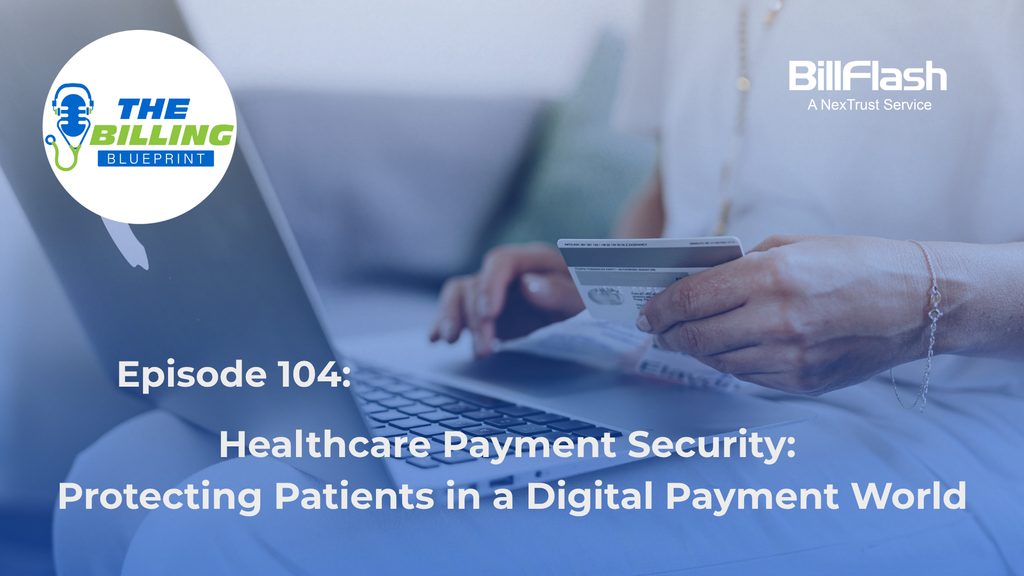
As healthcare payments become more digital, practices face a growing challenge: making it easier for patients to pay without compromising sensitive medical and financial information.
In this episode of the Billing Blueprint Podcast, we explore why healthcare payment security has become such an important part of the modern patient financial experience. From secure text and email notifications to authenticated payment portals, tokenization, PCI compliance, and HIPAA-conscious communication, we break down how practices can create a more convenient payment experience while protecting patient data.
The episode also looks at how payment flexibility, patient financing, collections, and vendor relationships affect both security and the overall billing experience. You’ll hear why disconnected systems and multiple third-party vendors can introduce additional risk—and how a more connected approach can help reduce complexity, strengthen healthcare payment security, and create a smoother experience for both patients and staff.
Tune in to learn how healthcare organizations can balance security, compliance, convenience, and affordability while building a payment experience patients can trust.
Transcript
Narrator: 00:01 Welcome to the Billing Blueprint Podcast, your go to resource for innovative medical billing solutions. Each episode we explore the latest industry trends and share proven strategies to help your practice, streamline operations and get paid faster. Now here are your hosts, Brad and Sarah.
Sarah: 00:23 So today we are taking a deep dive into this invisible and, honestly, highly vulnerable machinery behind your medical bill.
Brad: 00:30 It’s a huge topic.
Sarah: 00:31 It is. We’re basing this on an article from BillFlash, and the mission here is to really decode this massive balancing act going on behind the scenes of your healthcare.
Brad: 00:39 Because providers are in a tough spot. Right. They want to give you those frictionless, one-click payment options.
Sarah: 00:46 Right. The stuff you expect from modern e-commerce, like buying something on Amazon.
Brad: 00:50 Exactly. But they have to do that while simultaneously guarding your highly sensitive financial and medical data. Right. From, well, a constant barrage of cyber threats.
Sarah: 00:59 So to start us off, what’s the big picture here? Why is this such a pressing issue right now?
Brad: 01:04 Well, the macro view driving this whole shift is really the rise in insurance deductibles.
Sarah: 01:08 Oh, yeah, they just keep going up.
Brad: 01:10 Right. So patients are bearing significantly more financial responsibility for their healthcare than they did, say, a decade ago.
Sarah: 01:15 Which means you aren’t just a patient receiving care anymore.
Brad: 01:18 Exactly. You are a consumer paying a pretty substantial bill. And the stats back this up. 62% of patients now actively demand digital payment options.
Sarah: 01:28 Wow, 62%.
Brad: 01:30 Yeah. And the research in our source material clearly shows that the way a provider bills you actually impacts your overall satisfaction.
Sarah: 01:37 Like it dictates whether you ever go back to that clinic.
Brad: 01:40 Exactly. It’s a huge factor in patient retention.
Sarah: 01:43 That makes total sense. So whether you’re a patient who’s just tired of getting these confusing medical bills in the mail, you know, three weeks after you’ve recovered,.
Brad: 01:51 Or you’re a healthcare professional trying to modernize your clinic’s revenue cycle.
Sarah: 01:54 Right. We are going to unpack the architecture of how all of this actually works.
Brad: 01:59 We really have to start with the very first hurdle.
Sarah: 02:02 Getting the bill in the first place.
Brad: 02:04 Right. Before you can pay a bill, the doctor has to tell you what you owe, but they have to talk to you about money without breaking federal privacy laws,.
Sarah: 02:14 Which creates this massive communication paradox, right?
Brad: 02:17 Oh, absolutely. Because look at the source data. SMS text messages have a 98% open rate.
Sarah: 02:23 98%?
Brad: 02:24 Yeah.
Sarah: 02:25 That is huge.
Brad: 02:26 And most of those are read within three minutes of being delivered.
Sarah: 02:29 I mean, that tracks. If my phone buzzes, I look at it.
Brad: 02:32 Right. We all do. But compare that to traditional healthcare emails. Those sit at a really dismal 24 to 27% open rate.
Sarah: 02:40 So emails are basically just going into the void?
Brad: 02:43 Pretty much. Patients overwhelmingly prefer text messages. In fact, 68% want two-way texting just for simple questions.
Sarah: 02:52 But, and here’s the big “but” — a healthcare provider is bound by the Health Insurance Portability and Accountability Act.
Brad: 02:59 HIPAA.
Sarah: 02:59 Right, HIPAA. Because detailed medical billing information, like what specific procedure you were seen for, the diagnostic codes, the exact amount you owe — all of that is protected health information.
Brad: 03:11 It’s highly sensitive.
Sarah: 03:12 So if a clinic just shoots that over an unencrypted cellular network in a standard text message.
Brad: 03:17 Which is how normal texts work.
Sarah: 03:18 Yeah. If someone borrows your phone or intercepts that text, your private medical history is just totally exposed.
Brad: 03:24 And that’s the core conflict. How do you utilize the incredible efficiency of an SMS API without violating federal privacy laws?
Sarah: 03:32 So how do they do it?
Brad: 03:33 Well, the solution relies on heavily secured platforms that kind of act as an intermediary.
Sarah: 03:38 Okay, walk me through that.
Brad: 03:40 So the source outlines how BillFlash approaches this. They basically move the sensitive conversation out of the unsecured SMS environment entirely.
Sarah: 03:47 Oh, okay.
Brad: 03:48 Yeah, they use encrypted direct payment links via text or email, automated cadences that stop the second a payment is registered, and secure routing for patient questions.
Sarah: 03:58 Okay, let’s unpack this mechanism, because the way I’m picturing it, it’s kind of like a digital bouncer at an exclusive club.
Brad: 04:05 Okay, I like this. Go on.
Sarah: 04:07 So the text message you receive on your phone isn’t the club itself. The text message is just the bouncer tapping you on the shoulder saying, “hey, you have a VIP message waiting.”
Brad: 04:16 Right. He’s not shouting your medical history across the room.
Sarah: 04:19 Exactly. He doesn’t tell you what the message is or who it’s from. To actually hear the message and see your bill, he forces you to show your ID. You have to authenticate yourself.
Brad: 04:28 You prove who you are,.
Sarah: 04:29 And only after you prove your identity does he let you pass the velvet rope. Right. Into a secure, authenticated portal where the actual protected health information lives.
Brad: 04:38 That’s a great analogy. The text is just the notification, not the payload.
Sarah: 04:42 Right.
Brad: 04:43 And by separating those two things, the clinic leverages that 98% open rate of SMS. But they don’t take on the regulatory risk of sending protected health data over open cellular towers.
Sarah: 04:53 How do you keep that wall high enough to keep hackers out, but invisible enough that a patient can actually pay their bill without getting frustrated and just giving up?
Brad: 05:03 Because modern consumers are completely spoiled by e-commerce,.
Sarah: 05:06 We really are.
Brad: 05:07 Think about how you buy things online today. 84% of patients want an easy one-click checkout.
Sarah: 05:13 Wow. 84%.
Brad: 05:14 Yeah. And 65% expect a completely frictionless payment experience.
Sarah: 05:19 But delivering that in healthcare has to be incredibly hard.
Brad: 05:22 It is. Delivering that lack of friction across every channel, whether you’re tapping your phone in the office, calling the billing department, or paying online at 2 in the morning, it requires really complex access controls.
Sarah: 05:35 Right. The source mentions all these solutions, like automated recurring payments when a new bill drops, and storing a card securely for next time.
Brad: 05:43 All designed to remove friction.
Sarah: 05:45 But here is where I get really hung up. One-click checkout sounds fantastic if I’m buying like a $10 pair of socks on Amazon,.
Brad: 05:53 Sure.
Sarah: 05:53 But for a $1,000 medical bill, if I can one-click pay $1,000, that means my credit card information is definitely sitting on that clinic server somewhere, right?
Brad: 06:03 It would seem that way, yeah.
Sarah: 06:05 That seems incredibly dangerous. If they ever get hacked, doesn’t making it too frictionless open the door to massive fraud?
Brad: 06:11 That assumption is exactly why the architecture here is so important to understand.
Sarah: 06:16 Okay, explain it to me.
Brad: 06:17 When a patient saves their credit card on a modern healthcare payment platform, the system does not actually store your 16-digit credit card number in a database on the clinic server.
Sarah: 06:27 Wait, it doesn’t?
Brad: 06:27 No, because if it did, you would be absolutely right to be concerned.
Sarah: 06:31 Okay, so what are they doing instead?
Brad: 06:33 They use a technology called tokenization.
Sarah: 06:36 Tokenization. Okay, I’ve heard the term. But let’s break down how the payment gateway actually validates that.
Brad: 06:42 Basically, it’s a substitution.
Sarah: 06:44 It’s somewhat like handing your cash over for poker chips at a casino, right?
Brad: 06:48 Oh, that’s a good way to look at it,.
Sarah: 06:50 Because the chips represent the money inside the casino. But if someone robs you in the casino parking lot and steals the chips,.
Brad: 06:56 They can’t exactly spend them at the grocery store.
Sarah: 06:59 Right. They’re useless outside.
Brad: 07:00 Exactly. Let’s take that poker chip analogy a step further to explain the validation process.
Sarah: 07:05 Let’s do it.
Brad: 07:06 When you enter your credit card into the secure portal, that data goes directly to the payment processor.
Sarah: 07:11 Okay.
Brad: 07:11 The processor encrypts your card and hands the clinic back a randomly generated string of alphanumeric characters.
Sarah: 07:17 And that’s the token. The poker chip.
Brad: 07:19 Yes, that is the token. And crucially, that specific token only works between that specific merchant and that specific payment processor.
Sarah: 07:29 So the clinic only ever holds the token?
Brad: 07:31 Yes.
Sarah: 07:32 Yeah,.
Brad: 07:32 They never hold the card. When you hit that one-click checkout for your thousand-dollar bill, the clinic software simply hands the token back to the payment processor and says, “hey, charge the card associated with this token.”
Sarah: 07:44 Oh, wow.
Brad: 07:45 And the payment processor, who holds the actual highly secured vault, matches the token to your card and authorizes the transfer.
Sarah: 07:53 So the clinic staff never sees your actual card number at all?
Brad: 07:55 Never.
Sarah: 07:56 And hackers cannot steal it from the clinic servers because the raw data simply isn’t there to steal.
Brad: 08:01 That is brilliant.
Sarah: 08:02 If a hacker steals the token, it is just useless garbage data to them.
Brad: 08:06 Exactly. Yep.
Sarah: 08:07 Outside of that specific software environment.
Brad: 08:10 That explains how you achieve the speed of e-commerce without sacrificing the security of a bank.
Sarah: 08:14 Right. But you know, this leads us to a much heavier realization when we look at the source material.
Brad: 08:19 Yeah, the financial reality.
Sarah: 08:21 Because a beautifully designed, ultra-secure, completely frictionless payment portal is entirely useless if you simply do not have the money in your checking account to pay the balance all at once,.
Brad: 08:31 Which is the case for so many people. We are shifting here from technological friction to financial friction.
Sarah: 08:37 And this is arguably the most significant barrier in the American healthcare system today, isn’t it?
Brad: 08:41 Without a doubt. The technological machinery only works if the economics actually allow it.
Sarah: 08:47 The data in the source material, from a spring 2026 survey, it just highlights this crisis perfectly.
Brad: 08:53 The numbers are pretty stark.
Sarah: 08:54 They really are. 36% of patients completely avoided or delayed getting medical care over a six-month period specifically because of cost concerns.
Brad: 09:03 More than a third of people.
Sarah: 09:05 Just didn’t go to the doctor because they were terrified of the lump-sum bill.
Brad: 09:10 Delaying care predictably leads to worse health outcomes and, honestly, vastly higher medical costs down the road.
Sarah: 09:16 Right, because what starts as a minor treatable issue becomes a full-blown emergency room visit.
Brad: 09:22 Exactly.
Sarah: 09:23 But the survey also found that 47% of those people said they would be less likely to delay their care if they knew they had access to flexible payment plans.
Brad: 09:32 And this demand is heavily, heavily generational.
Sarah: 09:35 Oh, for sure. The stats show 80% of Gen Z and 76% of millennials have a strong preference for practices that offer installment plans.
Brad: 09:45 Because they are accustomed to subscription models.
Sarah: 09:48 Right. Breaking large purchases up into manageable monthly chunks is just how they operate.
Brad: 09:53 So to solve this financial friction, practices are integrating two distinct financial architectures into their billing platforms.
Sarah: 10:00 Let’s break those down. What’s the first one?
Brad: 10:02 The first is a self-serve payment plan. So the provider sets the financial guardrails behind the scenes. Like the minimum monthly payment they can afford to accept, the minimum balance eligible for a plan, and the maximum duration of the plan.
Sarah: 10:15 Okay, so they set the rules.
Brad: 10:16 Right. And then you, the patient, log into the secure portal and customize your own payment schedule within those parameters.
Sarah: 10:23 Which covers the smaller, more manageable balances pretty well.
Brad: 10:27 It does.
Sarah: 10:28 But what about a massive unexpected emergency bill? Like a clinic can’t always afford to wait two years to collect that money. Right. They have overhead, payroll and supplies to fund today.
Brad: 10:40 And that introduces the second architecture: patient financing.
Sarah: 10:44 How does that differ mechanically?
Brad: 10:46 The mechanical difference here is risk assumption. With patient financing, a third-party financing entity actually steps in.
Sarah: 10:52 Okay.
Brad: 10:53 They pay the healthcare provider the full amount immediately, minus a small discount rate.
Sarah: 10:57 So the provider’s books are cleared right away.
Brad: 10:59 Exactly. They have their cash flow. And then you pay that third-party entity back in convenient monthly installments.
Sarah: 11:04 And if you default,.
Brad: 11:06 If you default on that payment plan, the third-party financier takes the loss, not the local clinic.
Sarah: 11:12 Wow. Okay, so it is literally the buy-now-pay-later trend that just exploded in retail, but heavily integrated into the healthcare sector.
Brad: 11:20 That’s exactly what it is.
Sarah: 11:22 But looking at this, the financial mechanics are really only half the story, aren’t they? There is a massive psychological component here.
Brad: 11:28 Regarding dignity. Yes.
Sarah: 11:30 Yeah. The emotional relief of not having to negotiate your healthcare.
Brad: 11:33 It’s huge for patient compliance.
Sarah: 11:36 Just think about the traditional scenario. You are standing at the front desk of a quiet, crowded waiting room.
Brad: 11:41 Everyone can hear you.
Sarah: 11:43 Right? The receptionist tells you that you owe $800 and you just don’t have it.
Brad: 11:48 It’s a terrible feeling.
Sarah: 11:49 So you have to awkwardly ask in front of total strangers if you can pay it off over time. It is an embarrassing, degrading experience that makes people actively avoid going back.
Brad: 11:58 But if these self-serve payment plans and financing options are integrated directly into that secure portal on your phone,.
Sarah: 12:04 You completely bypass that interaction.
Brad: 12:06 Yes, you take the shame right out of it.
Sarah: 12:08 It quietly turns this terrifying lump-sum demand into a manageable subscription that you set up from the privacy of your own couch.
Brad: 12:15 And removing the shame and anxiety from the billing process directly increases patient compliance.
Sarah: 12:21 Because they aren’t afraid to go back.
Brad: 12:22 Exactly. When people maintain their dignity, they are far more likely to seek the follow-up care they actually need. And mathematically, they are far more likely to actually pay their bills.
Sarah: 12:33 But you know, we live in reality.
Brad: 12:35 We do.
Sarah: 12:36 Even with text message reminders and tokenized security and flexible financing, some accounts will inevitably go past due.
Brad: 12:43 Life happens. People lose jobs. Unexpected crises happen.
Sarah: 12:47 Right. Which pushes the patient journey into its most delicate and, honestly, legally complex phase.
Brad: 12:53 Collections.
Sarah: 12:54 Collections. And there is a ticking clock in medical billing that most people outside of the revenue cycle management industry just do not realize exists.
Brad: 13:02 The source material outlines a really steep drop-off.
Sarah: 13:06 Yeah, walk us through that timeline.
Brad: 13:08 So the likelihood of a practice collecting an unpaid bill drops by 10 to 15% every single 30 days it goes unpaid.
Sarah: 13:16 10 to 15% a month.
Brad: 13:18 It’s a rapid decay.
Sarah: 13:19 That’s huge.
Brad: 13:20 Once an account hits 90 days past due, it enters a high-risk category of becoming what they call “bad debt.”
Sarah: 13:26 And bad debt means what, exactly?
Brad: 13:28 At that point, the practice basically assumes they will likely never recover the cost of the care they provided.
Sarah: 13:33 So the clinic transitions the account to collections at that stage.
Brad: 13:36 Yes, often utilizing automated rules and bilingual specialists to try and reach some kind of amicable solution with the patient.
Sarah: 13:44 But this transition — this exposes a hidden danger in the machinery.
Brad: 13:48 It does.
Sarah: 13:49 This is where the cybersecurity reality really hits the pavement.
Brad: 13:52 Because up to 80% of all healthcare data breaches are linked to outside vendors.
Sarah: 13:56 80%. That is just staggering.
Brad: 14:00 It is. The vulnerabilities are rarely in the doctor’s internal systems. They exist in the third-party companies they hire to handle their messaging, their billing software, and their collections.
Sarah: 14:09 Which makes sense when you think about it, because if my clinic uses one application to send me text reminders — right — and then a totally different software platform to generate the bill, and a third company to process the tokenized credit card payments, and a fourth distinct agency for collections, doesn’t that just inherently multiply the risk?
Brad: 14:28 Oh, it expands the attack surface exponentially.
Sarah: 14:31 Right. It’s like… it’s like building a highly fortified medieval castle to protect your data. But then you hire 20 different contractors, and each one demands their own secret escape door built into your castle walls.
Brad: 14:42 That is a highly accurate way to visualize an API attack surface.
Sarah: 14:45 Because you no longer have just one main gate to defend. You have 20 separate locks that can be picked by hackers.
Brad: 14:50 Exactly. Every time a clinic’s core electronic health record system, the EHR, has to communicate with an outside vendor’s software, it requires an API integration.
Sarah: 15:01 And every integration is a door.
Brad: 15:03 Right. So if a small third-party collection agency is using outdated software or weak security protocols, hackers aren’t going to attack the heavily defended hospital.
Sarah: 15:13 Why would the.
Brad: 15:14 Right. They will breach the collection agency and literally walk right through that API door into the hospital’s main database.
Sarah: 15:20 Which means a single third-party breach can expose millions of patient records.
Brad: 15:25 Yes, which is why the source so heavily emphasizes vendor consolidation.
Sarah: 15:30 So it isn’t just about administrative convenience for the office manager. Like, so they only have one password to remember.
Brad: 15:35 No, not at all. It is a fundamental cybersecurity strategy.
Sarah: 15:39 Okay, that makes so much sense.
Brad: 15:40 The architecture detailed in the BillFlash article points to unified platforms that integrate directly with over 100 different EHR systems.
Sarah: 15:49 So it’s all in one place.
Brad: 15:50 Right. By handling the messaging, the billing, the payments, and the collections all under one roof, you eliminate those extra doors, you shrink the attack surface,.
Sarah: 15:59 And it also changes the legal liability. Right. The source mentions BAA and PCI compliance quite a bit. Let’s unpack the weight of those terms for the listener.
Brad: 16:08 Sure. So a BAA is a Business Associate Agreement.
Sarah: 16:11 Okay.
Brad: 16:12 And in the eyes of HIPAA, a BAA is not just a casual handshake. It is a legally binding contract mandated by the federal government that makes the vendor liable for protecting the data.
Sarah: 16:23 Wow. Okay.
Brad: 16:24 If a clinic shares your medical data with a vendor without a rock-solid BAA in place and that vendor gets breached, the clinic itself can be fined into oblivion by regulators.
Sarah: 16:35 That is a massive risk. And what about PCI?
Brad: 16:39 PCI compliance is similar, but it specifically governs the rigorous security standards for handling credit card data.
Sarah: 16:45 Right. The financial side.
Brad: 16:47 Right. So consolidating vendors means the clinic only has to audit and trust one BAA and one PCI compliance certificate,.
Sarah: 16:55 Rather than trying to police the security standards of five different companies at once.
Brad: 16:59 Exactly.
Sarah: 17:00 It’s much safer. So, stepping back, we’ve really mapped out the entire machinery here today.
Brad: 17:06 We have. It’s a lot of moving parts.
Sarah: 17:08 It is. We have walked through the five crucial pillars of a modern payment experience. First, navigating that tricky HIPAA communication paradox to actually meet patients where they are via text message. Second, balancing those frictionless one-click payments with the heavy-duty security of tokenization.
Brad: 17:24 The poker chips.
Sarah: 17:25 Exactly. Third, removing the financial barrier to care through integrated payment flexibility and financing.
Brad: 17:31 Preserving patient dignity.
Sarah: 17:33 Yes. Fourth, managing the ticking clock of collections respectfully. And fifth, utilizing vendor consolidation to lock down the data and shrink the cyber attack surface.
Brad: 17:43 The overarching theme woven through all of this really is that disconnected systems just fail everybody.
Sarah: 17:49 They really do.
Brad: 17:50 They create operational nightmares for the healthcare providers, and they create frustrating, frankly dangerous experiences for you, the patient.
Sarah: 17:58 And the ultimate takeaway from the source data is striking. 90% of patients say that the quality of the billing process and the ease of making a payment significantly influence whether they will ever return to that healthcare provider.
Brad: 18:10 Nine out of 10 people are making healthcare decisions based on administrative friction.
Sarah: 18:15 That is wild to think about,.
Brad: 18:17 But it means you have power in this equation. You are well within your rights to demand a better, more secure and more convenient billing experience from your doctors.
Sarah: 18:24 Because it is no longer just an administrative luxury for a clinic to offer these tools, is it?
Brad: 18:29 Not at all. It is a baseline standard of modern care.
Sarah: 18:32 Thanks for taking this deep dive with us. We’ll catch you on the next one.
Narrator: 18:37 Thanks for tuning into the Billing Blueprint Podcast. For more insights or to dive deeper into today’s topics, head over to billflash.com. Don’t forget to subscribe and we’ll catch you next week with more strategies to keep your practice running smoothly and getting paid faster.
Sources:
5 Ways to Create a More Secure and Compliant Patient Payment Experience